

Copy the “mountain-building” playbook that produced Taiwan’s semiconductor “sacred mountain,” and apply it to biomedicine to raise a second one. That is the blueprint John Hsuan, chairman of Hukui Biotechnology, has been laying out as he shuttles between government, industry, academia and research. Drawing on the business models of Jensen Huang and Elon Musk, he argues Taiwan should target the “incipient-disease” market and make cell therapy and medical devices its next wave.
John Hsuan, currently chairman of Hukui Biotechnology, argued in a recent speech that Taiwan should replicate the success of its semiconductor “sacred mountain” — the nickname Taiwanese give to the chip industry, led by TSMC, that is said to guard the nation — and turn cell therapy and the medical-device business within biomedicine into Taiwan’s “second sacred mountain.”
He believes this is the best possible moment: a new market for treating “incipient disease” is emerging, and Taiwan simultaneously possesses the industrial capability accumulated in semiconductors, a complete healthcare system, and the capital and talent to match. The timing, the conditions and the people are all in place. “Everything is ready; all that is missing is the will to act,” he said.
Hsuan once served as president of UMC and was a central figure in its development, spending his entire career in semiconductors. After retiring from UMC he moved into biotech entrepreneurship, founding Hukui Biotechnology — focused on CDMO (contract development and manufacturing) services — as well as Meridigen Biotech, which centers on stem cells. On how Taiwan’s biotech industry can apply the lessons of semiconductors, he has a fully worked-out view of his own.
Taiwan’s foundations are stronger — success is built on the groundwork beneath the mountain
First, he argues, Taiwan’s underlying strength has grown; it is no longer the country it once was.
He points to the data. Taiwan’s GDP per capita reached US$37,827, overtaking South Korea (US$35,960) for the first time and leading Japan (US$34,720) for a second consecutive year, according to IMF figures; it is projected to reach US$41,000 to US$44,000 by 2026, widening the lead. He also notes that the countries whose GDP and GDP per capita both exceed Taiwan’s now number just eight: the United States, Canada, Australia, the United Kingdom, Germany, France, the Netherlands and Switzerland. Taiwan, he says, has moved from “working for others to make a living” to “working for itself and creating value” — the level of a developed economy.
Second, he turns to what he calls the lessons of Taiwan’s own semiconductor industry: success did not fall from the sky.
Hsuan traces the industry’s origins: the first semiconductor laboratory at National Chiao Tung University in 1964; the pivotal 1974 meeting at the Xiaoxinxin (小欣欣) soy-milk shop; then ITRI’s electronics demonstration fab, the founding of UMC and TSMC, and the later spin-offs such as MediaTek from UMC.
From that history he distills the most important ingredients of success. First, a government that “wanted to get things done, trusted people, and drove things through efficiently.” Second, teams that were young and bold and willing to plan for the long term. And most important of all, in his words: “The mountain did not come from the sky; it was built on the groundwork beneath it.”
He also stresses the importance of Taiwanese culture — working with one mind, mutual trust and forbearance, selfless contribution — as the most precious gene for building a mountain. These experiences, he says, are the methodological skeleton for developing biotech. To build a biotech mountain, the industry must follow the logic of semiconductor development and lay the groundwork first.
As for why Taiwan should choose biotech, his answer is that this is the third wave of industrial creation in human history.
He divides that history into three waves of creation: the first was “kinetic energy” (the Iron Age); the second, “intelligence” (the silicon age); and the third, “life energy” (the cell age). Biotech, he says, is the next great wave.
He compares Taiwan with Switzerland, arguing that “if Switzerland can, Taiwan can do even better.” Switzerland has a world-famous biotech sector, along with finance, tourism and precision watchmaking, but services account for as much as 70% of its GDP, leaving little growth momentum; in Taiwan, technology manufacturing and industry account for 35% and are still growing. “Add the momentum of a biotech industry on top, and Taiwan will see an explosion,” he said.
Within biotech, he places particular emphasis on the power of cells and on documented cases.
“Underestimating” and “overlooking”: how advanced Western semiconductor nations fell behind in manufacturing
In his presentation, Hsuan devotes considerable space to the value of cells — stem cells that “strengthen the self,” immune cells that “fight and kill disease” — noting that both decline with age and therefore need replenishing.
He cites several documented cases in support: during COVID, Meridigen and Shuang Ho Hospital used a new stem-cell drug to save four of five critically ill patients (three of whom were already on ECMO); the entertainer Chou Yu (周遊); a Yunlin county councilor (陳芳盈) who returned to work after a car accident; a young girl with cerebral palsy and a boy with a brain injury; and active elderly cases such as a 91-year-old (翁肇喜) and a 73-year-old (方國健).
His central appeal: people like to ask how long they can live, but the better question is “how long can you live healthy, how long stay sharp, how long stay happy.” What people should pursue is living in health — “no machines, no organ transplants.”
Next, he stresses that the policy path is already paved, above all in the lessons of the Specific Medical Techniques Regulations — the framework, known in Taiwan as the “tekuanfa,” that governs applications to perform cell-therapy techniques. Since the regulations took effect, 554 applications had been filed and 408 approved as of mid-2025, which he says shows the government has actively cleared the way. Hsuan optimistically forecasts three trends ahead: applications rising from 500 to 5,000 and then 50,000; the success rate climbing from 20% to 80%; and costs falling from NT$10 million to NT$3 million and then NT$1 million.
Most important, he says, if biotech is to learn from semiconductors, it must first understand today’s pain points and build a methodology.
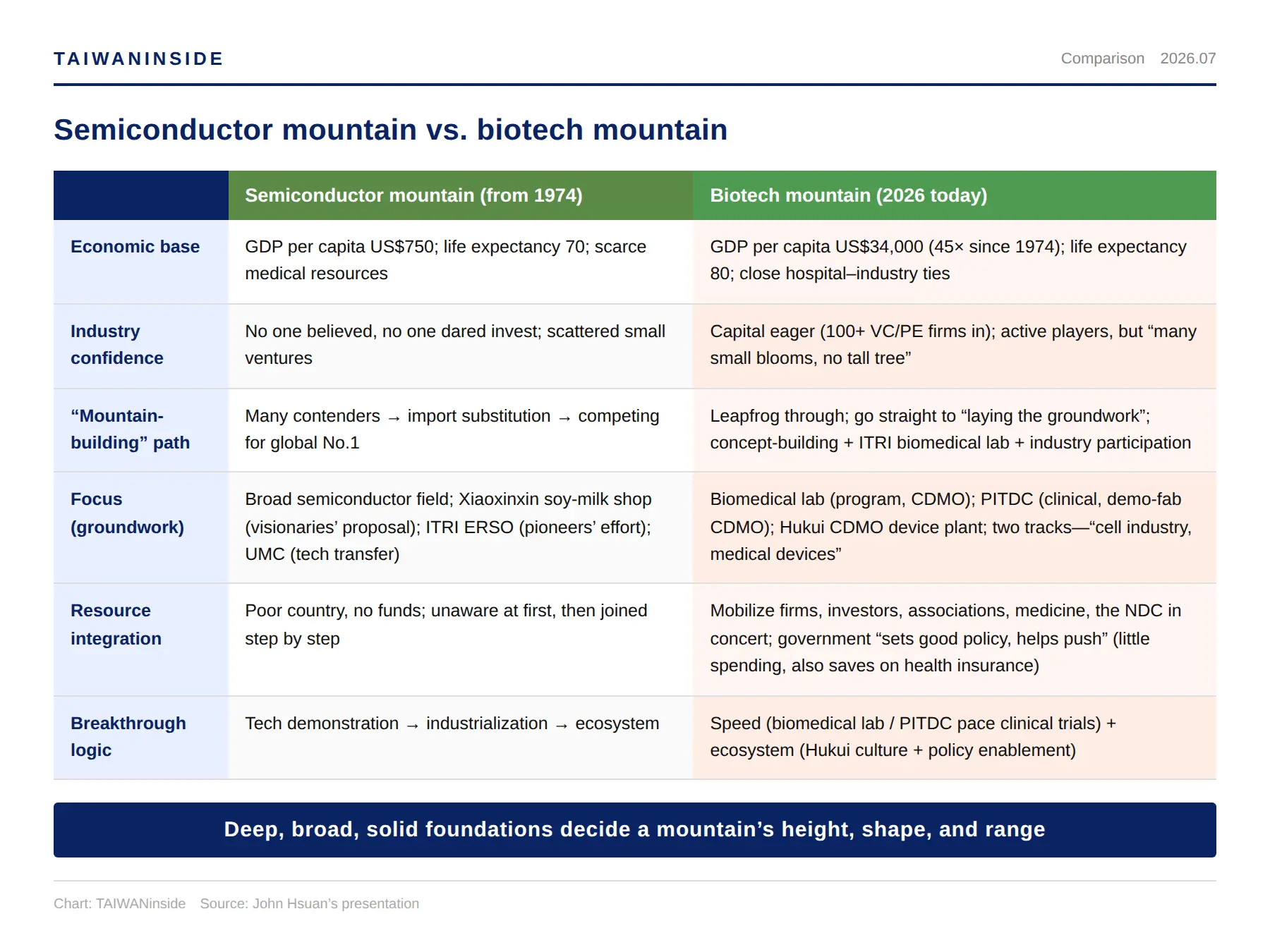
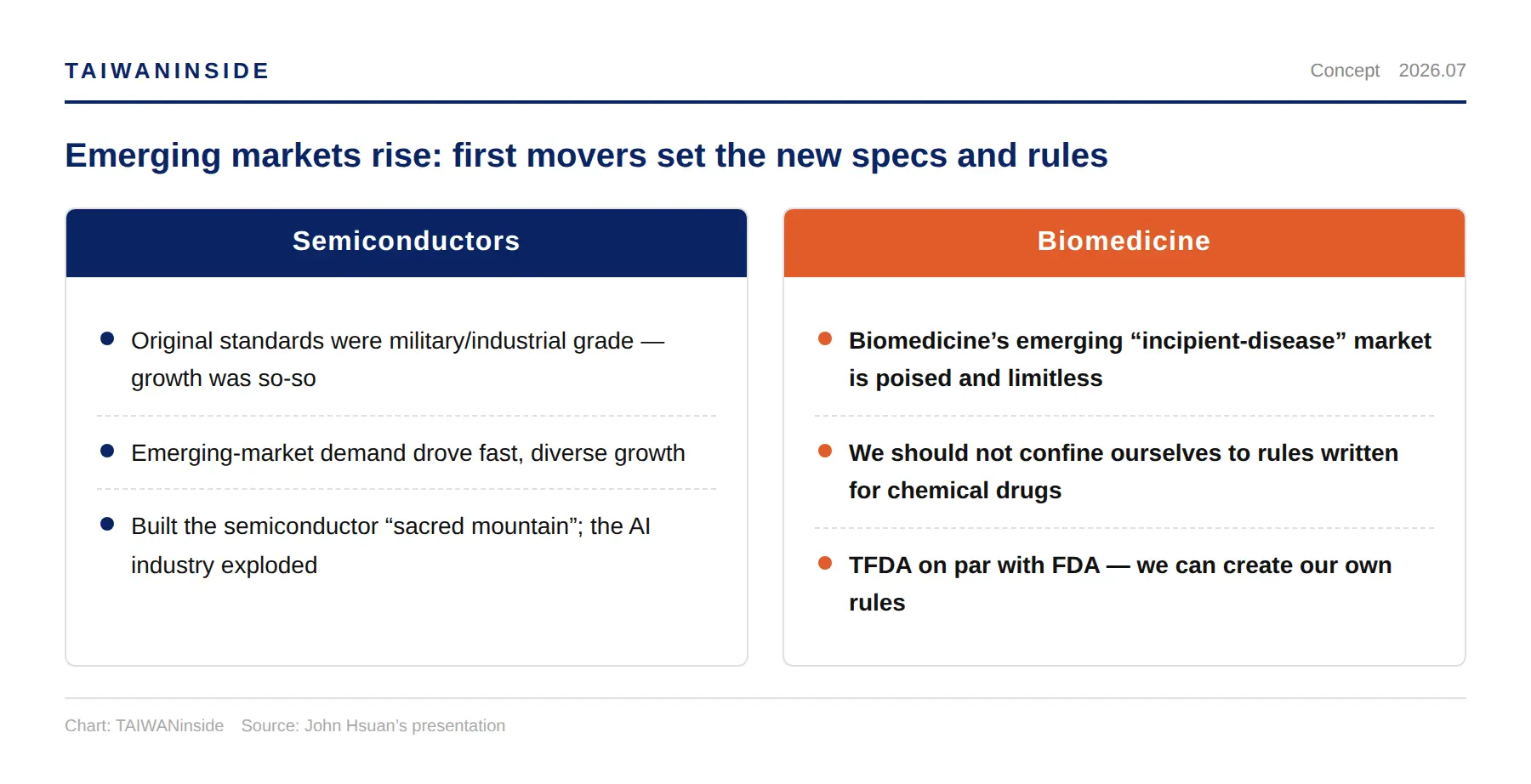
John Hsuan’s comparison of semiconductor versus biotech mountain-building — source table
He is blunt about the current state of biotech: “no shortage of projects, no shortage of investment — but too much, too scattered, too slow, too fragmented.” Ambitions are small and eyes exceed hands, he says, which is why no great success has yet emerged.
The solution is to find the hard problems and take them on. Citing Nvidia’s algorithms and business model, and SpaceX’s trend calculus and business model, he stresses that technology is an important source but not the sole key to winning; the most important solution is to use technology well and find a business model.
He then shares his semiconductor experience. Advanced Western semiconductor nations fell behind in manufacturing, he argues, as a result of two things: “underestimating” and “overlooking.” Even now, he adds, US President Donald Trump still does not understand this, and keeps saying that Taiwan stole America’s semiconductors.
By “underestimating,” he means that leading Western nations underestimated the fact that “manufacturing and IC design are inseparable.” Because of that, the West assumed it could design ICs itself while leaving manufacturing to less-advanced countries, handing it all to Asia — until it could no longer do the work itself. Taiwan, by contrast, kept getting better and came to lead the world.
By “overlooking,” he means overlooking that “the IC is an active component with innovative functions, and the source of the system.” The United States has excellent IC design firms and commands systems, but because advanced nations fell behind in manufacturing, their grip on some systems weakened too — especially after the rise of mainland China, which can now make many systems itself, a growing threat to the advanced nations.
Staying in the market: how Jensen Huang became the biggest winner
Hsuan also singles out his observations on why Nvidia succeeded, and his own encounters over the years with Nvidia CEO Jensen Huang.
Huang’s success, he says, grew from a childhood love of video games and a deep, persistent commitment to the field. Nvidia’s GPUs were not the best of their day, but many rivals pulled out early — making a little money and quitting — while Huang alone stayed in the market, and ended up the biggest winner.
In the early years UMC, too, wanted Nvidia’s orders. Hsuan recalls three exchanges with Huang about business. The first time, Huang told him: “Nvidia gives its foundry work to TSMC, not UMC. Because they’re a small company, they can only place one order at a time — they can’t bet on both sides.” Later, Huang came to UMC a second time and told Hsuan, “TSMC won’t make improvements, so I might come to UMC,” giving him a flicker of hope. But at a third meeting he said UMC was no longer needed, because “TSMC won’t need to improve either — I’ll just go straight to the next-generation product.”
Nvidia’s technical strength lies in vector processing, and its algorithms are faster than Intel’s, Hsuan says, but the most important thing is that Nvidia built a formidable business model. Intel supplies the CPU component for a PC, but a CPU is confined to a component within a system: if the system sells for US$100, the CPU cannot sell for more than US$100.
Nvidia’s business model has no such limit. GPUs are used for cloud computing, and the compute market is hard to price — it is worked backward from the value it can contribute. Today the value a cloud AI computing center can create is limitless, so the price of a GPU can be boundless, expensive beyond belief.
He also points to SpaceX, the space-communications and AI-computing company much in the news. Musk’s business model is even more boundless: satellites used to be expensive, but as technology advanced their cost could fall to a hundredth; SpaceX keeps launching and lowering costs, and won over NASA. It is, again, a good example of using technology well, finding a method, and building a business model.
With so many successful cases in technology and semiconductors behind him, Hsuan sets out a concrete execution strategy for developing Taiwan’s biotech industry — the fruit of many years of hands-on experience and reflection.
When the “incipient-disease” market exceeds the “manifest-disease” market — and eases the health-insurance burden too
Strategically, he argues that biotech consumes no water, no electricity, no land and no labor, making it the best choice in an environment of chronic shortages — the “five or six shortages” of land, water, power, labor and talent. But it must be done with “professional assessment, quality over quantity,” discarding the “a prize for everyone” mindset and assembling professional teams to back the best with precision.
At the execution level, he proposes compressing the timeline from R&D to production, and from certification to market, from 36 months to 18. The methods can be borrowed from semiconductors: switching from serial to parallel, buying insurance and spares, and SUPER HOT LOT-style production.
On the clinical side, he champions the experience of Taiwan’s clinical-trial center alliance (TACTC) — which integrates 32 institutions across Taiwan — moving toward “single review, nationwide mutual recognition” of Institutional Review Boards (IRBs), and building clinical trials into Taiwan’s most important competitive strength and “the world’s best clinical base.”
On the market side, he argues that “being able to sell is what matters most”: tend to the internal cycle first, and for the external cycle prioritize ASEAN and Taiwan’s diplomatic allies.
Hsuan also sets out what he considers the best business model: Taiwan, he says, is best suited to target the “incipient-disease” market.
Citing the ancient physician Bian Que — “the superior doctor treats disease before it arises, the middling doctor treats incipient disease, the inferior doctor treats manifest disease” — he boldly predicts that “the incipient-disease market will be larger than the manifest-disease market,” and notes that this market has no fixed rules yet, so first movers can set their own. Economically, treating incipient disease yields “spend one dollar to save at least three, and in time even ten,” while easing the health-insurance burden at the same time. Taiwan’s manifest-disease market runs to NT$1.2 trillion (about US$37 billion) a year, and almost all the money goes there.
He argues that Taiwan’s Food and Drug Administration (TFDA) should be more proactive, and that Taiwan can set its own rules. In the past the TFDA has taken its lead from the US Food and Drug Administration (FDA), but he believes Taiwan’s TFDA can run ahead of the FDA, and need not be confined to the rules originally written for chemical drugs.
Finally, Hsuan sums up four cornerstones for building the biotech mountain: first, a national office for biotech mountain-building; second, a management system for incipient-disease prevention and regenerative drugs and medical technologies; third, a talent-scout team to quickly discover the stars of tomorrow; and fourth, rapid advancement of the TACTC clinical-certification alliance.
He also calls for biotech development to be kept free of political interference — “no blue, green or white, only Taiwan’s future” — and urges people to “sing of growth, not decline.” Taiwan’s semiconductors have been very successful, he says, but semiconductor Taiwan is a “half cycle,” while biotech Taiwan would be a “full cycle” — fully autonomous from technology, R&D, translation and certification through to manufacturing and marketing. “Rapid, cyclical progress is the only path to success.”
To promote a view of biotech development built up over many years, Hsuan has not only published a book on stem cells; from July 2025 to March 2026 he made an intensive round of visits to government, industry, academia and research bodies — including the Ministry of Economic Affairs, the Ministry of Health and Welfare, National Cheng Kung University, Taipei Medical University, ITRI, the Pharmaceutical Industry Technology and Development Center (PITDC), and the Center for Drug Evaluation (CDE) — and pushed various alliances, such as those with Meridigen, an NK-cell company (艾沛) and an AI-diagnostics company (先勁智能). He does not merely give speeches about a vision; he is actively driving one action plan after another.
Media source : TAIWANinside – 深入解析台灣半導體最新動態
Who is Lin Hungwen?
He’s one of Taiwan’s top reporters covering tech and the IT industry, especially the semiconductor sector, and has been at it for over 30 years. He graduated from NYCU University in Taiwan with a degree in Electrical Engineering and also earned a master’s in Economics from Nankai University in China.
After working at Taiwan’s Economic Daily, he joined the financial magazine ‘BusinessToday’ as Deputy Editor-in-Chief. He now also serves as an independent director at Radiant Opto-Electronics and T-Conn Precision. From starting out as a rookie reporter to doing in-depth interviews with TSMC founder Morris Chang, he’s written many important exclusive stories. He currently runs his personal blog www.taiwaninside.com, with content in Chinese, English, Japanese, and Korean.
His works cover companies like Samsung, MediaTek, UMC, and HP. Recently, he published ‘The Shine on the Chip Island,’ which came out in Taiwan in 2023 and was later released in Japanese, Korean, and English. The book shows how Morris Chang overcame multiple crises and turned TSMC into a top global semiconductor company.